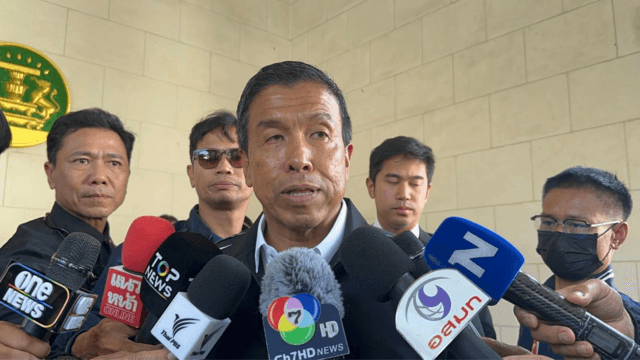
Veteran politician Chalerm Ubumrung and his son and political heir, Wan, are back in the media spotlight after stirring up a storm in the ruling Pheu Thai Party.
Their latest moves have created headaches for Pheu Thai’s bosses, including leader Paetongtarn Shinawatra and her father, former prime minister Thaksin, who is seen as the party’s de-facto chief.
Chalerm, 77, recently made damaging remarks against Thaksin while daring Pheu Thai to expel him so he could join his son in a new party while retaining his MP seat.
Wan, 49, quit Pheu Thai last month and joined coalition partner Palang Pracharath after being scolded by Paetongtarn for meeting a “party rival”. Father and son had paid a June 30 visit on Kamronwit Toopkrajang amid his bid for re-election as Pathum Thani Provincial Administrative Organisation chief against Pheu Thai candidate Charn Phuangphet.
Observers said Chalerm launched his retaliation after the Pheu Thai bosses targeted his soft spot – his family, especially his three sons.
Second son Wan appears to be Chalerm’s favourite after following in his father’s footsteps to become a politician.
A former police captain, Chalerm is known for being fiercely protective of his children. In October 2000, he ran into a Bangkok police station and screamed at the officers inside after his youngest son, Duang, was detained for his involvement in a scuffle. Chalerm has also angrily rebuked reporters for inquiring about his sons.
Veteran political heavyweight
Born in Bangkok on June 10, 1947, Chalerm earned bachelor's, master’s and doctoral degrees in law at Ramkhamhaeng University.
Before entering politics, he served in the Army as a corporal and then as a police captain in the Crime Suppression Division. While serving in the police force, Chalerm joined a failed coup attempt in April 1981, which resulted in his expulsion from the service. An amnesty granted to the coup-makers meant he avoided time in prison.
In 1983, Chalerm began his political career at the age of 36 when he was elected as a Bangkok MP with the Democrat Party. Three years later, he set up his own political party,
Muanchon (meaning the masses or the people), and served as its leader. His party’s stronghold was the Thon Buri side of Bangkok, especially the Bang Bon district where he lives.
Chalerm has served in several key ministerial positions during a career lasting more than four decades. He was Prime Minister’s Office minister under the Chatichai Choonhavan government between 1988 and 1990.
Later, he became justice minister in the Banharn Silapa-archa administration, serving from 1995 to 1996.
Chalerm also served in three governments led by Thaksin proxies – as interior minister under Samak Sundaravej, public health minister under Somchai Wongsawat, and deputy prime minister and labour minister under Yingluck Shinawatra, Thaksin’s sister.
After the Chatichai government was deposed by a military coup in 1991, Chalerm fled to Europe. He was among its Cabinet members accused of being “unusually wealthy” – a euphemism for corruption. He returned to Thailand a few years later and was elected an opposition MP.
Spilling the beans
Chalerm awarded Thailand’s first cable TV concession to the Thaksin-owned IBC while serving as PM’s Office minister in charge of the state-run Mass Communication Organisation of Thailand (MCOT) in 1990. This was four years before Thaksin entered politics.
At a recent press conference at his house, Chalerm declared that he had helped “someone get rich from scratch”.
“I don’t want to name any names, but everyone knows him,” he said.
The veteran politician also claimed to have “taken care of” seven legal cases for Thaksin while the fugitive ex-PM was living in self-imposed exile. As deputy prime minister in Yingluck’s government, Chalerm also oversaw the Justice Ministry and the Royal Thai Police.
During a rare group interview with the media last month, Chalerm threatened to spill more beans about Thaksin – especially secrets he claims are known only to him – if Pheu Thai continued ignoring his call to be expelled.
He also threatened to become an “independent MP” within Pheu Thai and stand against his party during debates and votes in Parliament. However, he has yet to follow through on that threat.
In 1998, Chalerm merged his political outfit with the much larger New Aspiration Party (NAP) led by General Chavalit Yongchaiyudh. He joined Thaksin’s Thai Rak Thai (TRT) in 2005 after it merged with the NAP.
After TRT was dissolved by a court order in 2007, Chalerm hopped aboard Thaksin’s proxy People Power Party (PPP). He then joined its successor, Pheu Thai, in 2008 after PPP was disbanded by a court order that same year.
Son and grandson
Wan was born in Bangkok on August 12, 1974 and earned a bachelor’s degree in law and a masters’ in political science from Ramkhamhaeng University.
Growing up, Wan and his two brothers frequently made headlines over altercations and assaults at nightspots.
Wan was first elected as an MP in 2019 under the Pheu Thai banner after previous attempts, under the NAP in 2001 and Pheu Thai in 2011, had failed. He sought re-election in his home constituency at last year’s national poll but lost to a candidate from the Move Forward Party, which swept the capital.
While Pheu Thai was in power, Wan was appointed to posts by several of the party’s government ministers. He served as an adviser, assistant secretary, and was vice minister for public health when he left Pheu Thai last month.
His 27-year-old son Archawin has remained with Pheu Thai, however.
Last month, Wan dismissed media reports that Archawin would join his father and grandfather at Palang Pracharath.
Archawin is not an MP, instead serving Pheu Thai as an adviser to its Digital Economy and Society Minister Prasert Jantararuangtong.
He is an alumnus of Thammasat University’s Social Policy and Development Programme and is pursuing a higher degree at the University of London’s School of Oriental and African Studies (SOAS).