


Jakarta--Former Prime Minister Abhisit Vejjajiva said he wanted to revive the struggling Democrat Party and transform it into a credible alternative in the next general election.
In his first overseas appearance since being re-elected as party leader on September 20, Abhisit traveled to Jakarta, the capital of the world’s largest democracy.
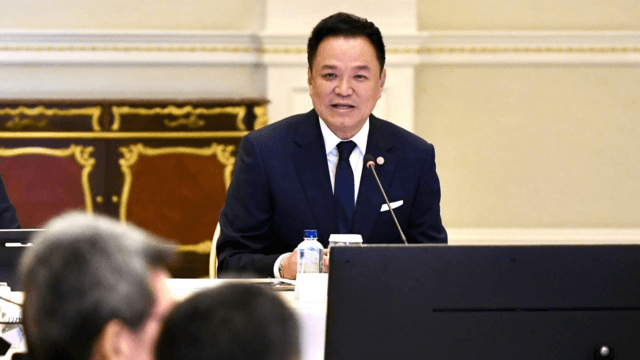
For two and a half hours, he spoke about his experiences in Thai politics as prime minister and now, once again, as leader of the Democrat Party. He also shared key lessons he has learned from decades in public life.
Throughout the open and candid dialogue, Abhisit answered every question directly. The session was moderated by Professor Nobuhiro Aizawa, Dean of the School of Government at the Research Institute for ASEAN and East Asia (ERIA), a noted Japanese scholar on Southeast Asia.
Abhisit, who served as prime minister from 2008 to 2010, reiterated that politics and leadership must focus on serving the people’s real needs rather than pursuing power for its own sake. He stressed the importance of accountability, transparency, and principle-based leadership, especially in public office.
When asked about Thailand’s turbulent political years in which he played a major role, Abhisit said leaders must learn to adapt and respond to unforeseen events while maintaining steadiness and purpose.
He noted that external conditions can shift rapidly, and leaders must anticipate change, adjust, and sometimes pivot their strategies rather than simply maintain the status quo. “Leaders must be ready to make difficult and sometimes unpopular decisions,” he said.
Drawing from his nearly four decades in politics, Abhisit underscored that a leader’s credibility is built over time through consistency, integrity, and meaningful action.
He acknowledged that missteps or controversies can easily erode public trust and rebuilding it is often much harder—something he has learned firsthand from his government’s experience.
During his lecture, Abhisit emphasized the need for both a clear vision—where a leader wants to go—and concrete mechanisms—how to get there. Leaders, he said, must manage both “the dream” and “the delivery.” He cited his “People’s Agenda” program as an example, which aimed to put people first through social welfare and infrastructure policies during his premiership.
Abhisit concluded that leadership is not a one-time achievement but a continuous journey—one that requires learning, reflection, adaptation, and sometimes the humility to step back and reposition.
Looking ahead to his third term as party leader in 2025, Abhisit said his goal is to rebuild the Democrat Party by bringing in young, energetic members who can help modernize Thailand’s oldest political party and make it relevant to future generations.
He added that the makeup of the Thai parliament is now considered younger than it was even a few years ago. Young Thais are going into politics. But he also said that they are getting the chances but they might not yet reach the topmost level. It takes as it is a process..
He wrapped up his lecture by give an analogy to describe the current state of Thai politics. "Think of Thai Polics as a new technology, a new gadget. You don't need to understand it. j\ust know how to use it."