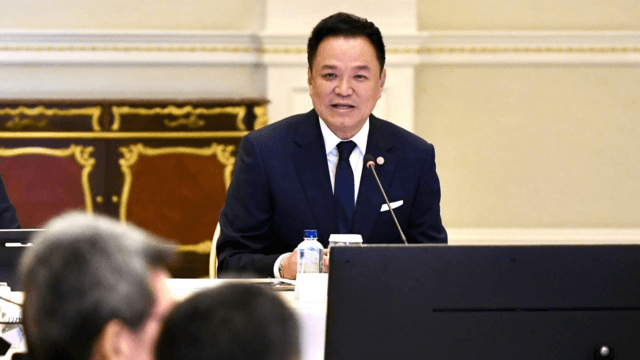



Two stunning verdicts by the Constitutional Court within a week not only shook up Thailand’s political landscape, but also sparked debates about the rule of law, the state of democracy in the country and their impact on the economy.
Thailand’s major trade partners, the United States and the European Union, have expressed concerns about the two verdicts — the dissolution of the main opposition Move Forward Party on August 7 and the dismissal of Srettha Thavisin from the post of prime minister on August 14.
Foreign media in democratic countries are viewing the court verdicts — especially the banning of a political party — as the establishment clamping down on progressive forces in the country.
Thai economists and business leaders are worried about their impact on investor confidence and the economy as a whole due largely to the power vacuum after Srettha’s exit and the time it would take for a new PM to form the Cabinet, amid a backdrop of slower economic growth, an aging society and geopolitical tensions.
They have called for the forming of a new government as soon as possible.
Responding swiftly to those concerns, the majority of members in the House of Representatives — mostly from the existing ruling coalition — elected Paetongtarn Shinawatra, the Pheu Thai Party leader and daughter of former premier Thaksin Shinawatra, as the new prime minister on August 16.
The 31st PM would need some time after royal endorsement to form a new Cabinet, which could then start work, and this time lag might delay public spending. Prospective investors may also wait on the sidelines for the new government to lay out its policies.
Impact on economic growth
InnovestX Securities Co has downgraded its economic forecast for Thailand to 2.3 per cent from 2.5 per cent this year and to 2.7 per cent from 3 per cent next year, its head of economic research Piyasak Manason said.
He explained the lower forecast to the likely delay in public spending from the fiscal year 2025 budget by two weeks to a month due to the political changes.
Spending under the fiscal year 2024 budget had already been delayed by many months due to the power struggle that ensued after the May general election in 2023.
This delay in spending was blamed for the low growth of just 1.9 per cent in the first quarter of this year. Observers believe that the formation of the new government might take some time.
The stock market reacted negatively to the dismissal of Srettha. The Stock Exchange of Thailand index dropped for two days in a row after the court verdict, although there was a rebound on August 16 when Parliament picked Paetongtarn as the new prime minister.
In the worst-case scenario, the index could slide to 1,250 points this year, said Piyasak.
Kriangkrai Thiennukul, president of the Federation of Thai Industries (FTI), urged the coalition parties to form a new government as soon as possible in order to win back investor confidence.
He said foreign investors were asking the FTI about the latest political developments and many may adopt a wait-and-see approach in relation to new investment in the country.
Doubts over the digital handout scheme
The new PM has not made a clear comment on whether her government would implement the controversial digital wallet handout scheme initiated by the Srettha government.
Many social media users have expressed their concerns about the fate of the digital wallet scheme under which the Srettha government promised to give Thai citizens aged over 16 a one-time handout of 10,000 baht each.
The scheme is not rid of legal hurdles yet, while the Bank of Thailand and many economists oppose the scheme as a waste of public funds.
The digital wallet scheme should be scrapped due to the high opportunity cost, in the opinion of Prof. Sakon Varunyuwatana, former dean at Thammasat University’s Faculty of Economics.
It will be much better to spend the money on productive investment instead of short-term consumption stimulus, he suggests. Or, the cash handout should be a targeted approach and be given only to vulnerable groups, he says.
Money should be saved for harder times, as there is the threat of a global recession and the escalation of war in the Middle East and Europe, he argues.
Paiboon Nalinthrangkurn, president at the Investment Analysts Association, is worried that the large stimulus package would further increase public debt.
The new government does not need to give 10,000 baht each to 50 million people as planned by the Srettha government.
It could give the handout to 10-15 million people who are really in need, while the rest could be supported by a co-payment scheme or the tax refund-for-shopping scheme implemented earlier.
Other critics have long warned that Thailand’s political instability has made the country less attractive for investment compared to Indonesia, Malaysia and Vietnam.
Meanwhile, political scientist Panitan Wattanayagorn said that Paetongtarn comes from a political dynasty and that could be helpful, but she herself has no experience in running the government as she has never been a minister while people have high expectations from her.
“An immediate challenge is to tackle the high cost of living,” Panitan added.
Photo: Reuters