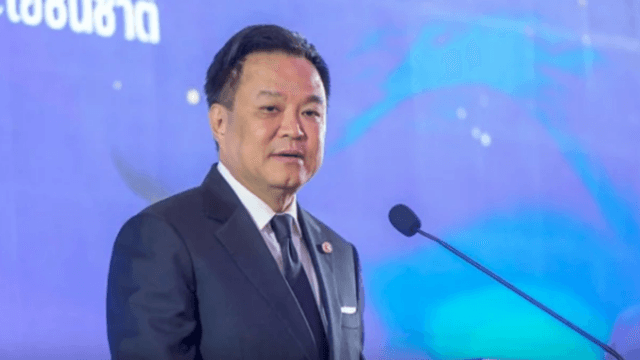



Facing global supply chain disruption and the rise of protectionism, Deputy Prime Minister and Finance Minister Ekniti Nitithanprapas is urging Thai businesses to transform immediately, pointing to ESG adoption, technology integration, and agile supply chain networks as the cornerstones of long-term competitiveness.
Speaking at the “TSCN Business Partner Conference 2025” during the Sustainability Expo, Ekniti said investing in AI, data analytics, and decarbonisation is no longer optional.
“These are now the licences that allow us to play in the global market,” he noted, stressing that companies must move beyond short-term transactions toward regional collaboration and resilience.
He warned that the global economy has shifted from free trade to “a world of choosing sides.” Nations increasingly trade within their blocs, forcing supply chains to realign.
Cheap raw materials are no longer enough as tariffs and non-tariff barriers, including stricter inspections, reshape trade. “The old world of free trade is gone,” Ekniti said.
This shift affects both economies and societies, including the movement of people. He pointed to the “China Plus One” strategy, where firms diversify production outside China to reduce risk. Thailand must adapt quickly to capture such opportunities.
Domestically, he acknowledged that the government has only four months but must act with urgency. “Our principle is to grow the economy in parallel with ESG—economic growth must go hand in hand with environmental care, social responsibility, and good governance.”

The economic outlook is fragile. Ekniti compared it to “a car heading off a cliff,” with exports front-loaded ahead of new U.S. tariffs and growth in the fourth quarter projected at only 0.3%.
To prevent stagnation, the government is applying short-term stimulus while preparing structural reforms to strengthen competitiveness, broaden participation, and reduce inequality.
“There is no such thing as ESG Plus,” he stressed. “Business and ESG are inseparable. Likewise, growth must come with fiscal discipline and governance to avoid a crisis like in 1997.”
Demographic challenge
Thailand’s rapid demographic shift compounds the problem. One in five Thais is now over 60, compared to the global average of 15%. This aging population is straining labor supply, social security funds, and public healthcare while weakening domestic consumption.
Yet Ekniti framed this as both a threat and an opportunity. “Thailand can capitalise on senior-focused sectors—nutrition, world-class hospitals, and wellness—turning demographic change into new sources of income.”
Human capital, AI, and “agilability”
To bridge labor shortages and meet new workforce expectations, Ekniti called for widespread reskilling and lifelong learning. “The younger generation is more demanding; they seek more than just a job. Businesses must adapt their appeal,” he said.
He urged companies to foster “agilability”—the ability to adapt rapidly to change—by embedding technology at the core. “AI and data analytics allow businesses to make good decisions quickly, becoming faster, leaner, and more competitive,” he said. “The goal is to ignite human power, accelerate startups, and create collaboration with better speed and efficiency.”
Tackling Inequality and supporting SMEs
Income inequality remains one of Thailand’s deepest challenges. While the richest 20% account for 55% of GDP, the poorest 20% share just 6%. “Developed nations became rich before they became old. Thailand risks becoming old before it becomes rich,” Ekniti warned.
To counter this, welfare card expansions and co-payment schemes are aimed at low-income households, while SMEs will benefit from soft loans, supply chain financing, and tax incentives to integrate them more firmly into global value chains.
Digital and green transformation
Ekniti highlighted two non-negotiable transformations: digitalisation and the green economy. The rapid leap from analog to AI is disrupting industries, and firms that fail to adopt robotics, automation, or decarbonisation risk exclusion from global supply chains.
“Decarbonisation has become a licence to play,” he repeated, urging industries to share best practices in building green supply chains and avoid duplication of mistakes.
The government is also pushing reskilling programs, clean energy projects, and green finance tools to establish Thailand as a regional hub for sustainable growth.
“The economy is skidding toward a cliff. If we act decisively, we can not only stabilise growth but also build a stronger foundation for competitiveness,” Ekniti concluded.
He called on the private sector to step forward as the key driver of transformation, working with government to ensure Thailand adapts to global disruption and secures an inclusive, sustainable future.