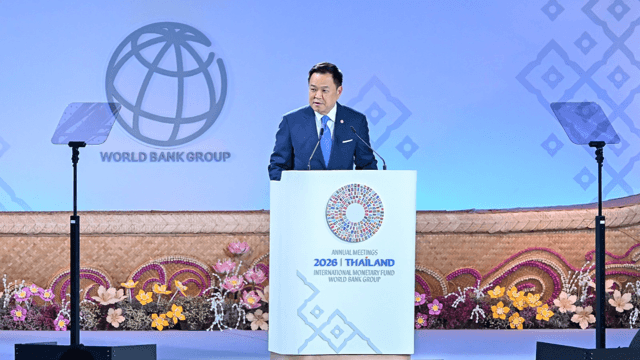
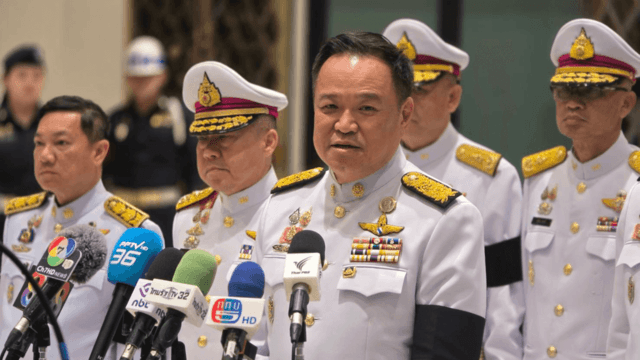
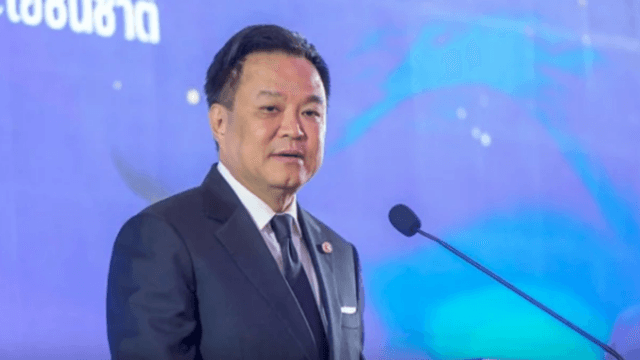
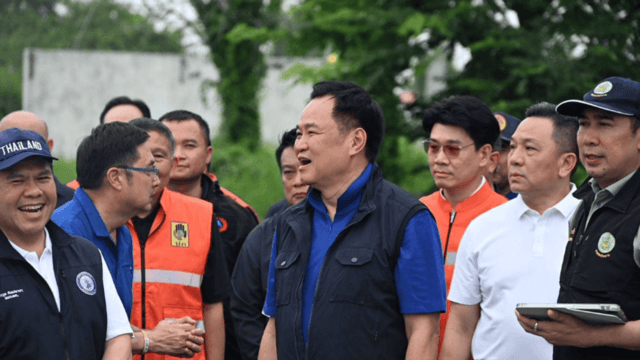
Prime Minister Anutin Charnvirakul’s push to crack down on scam networks is being met with scepticism, drawing heightened scrutiny of his government by the opposition and civil society.
Firmly placing the issue on the national agenda, the prime minister declared a war on scammers on November 6 to demonstrate his political will to tackle the problem.
Tackling tech-spawned crime
“Today marks an important step as Thailand unites to declare war on online crime. This is a battle that we cannot afford to lose, to protect all our people from the threats posed by scammers who are undermining the country every day,” Anutin said.
On the same day, Anutin, who is also the interior minister, presided over the signing of a memorandum of understanding (MOU) by 15 relevant government agencies concerning security and crime suppression.
They included the Interior Ministry, the Royal Thai Police, the Anti-Money Laundering Office, the Office of the Public Sector Anti-Corruption Commission, the Ministry of Digital Economy and Society, the Bank of Thailand, the Department of Special Investigation, the Securities and Exchange Commission, and the National Broadcasting and Telecommunications Commission.
“What we have signed is not merely a document but a strategic instrument in our systematic effort to combat criminal networks,” Anutin said, adding, “this is a national agenda, not the responsibility of any single agency, but a shared mission of the entire country.”
He affirmed that his government stood ready to provide full support in all aspects, including budget, technology, policy and resources, to ensure that operations to suppress technology-related crime, particularly online scams, achieve tangible results in both the short term and sustainably over the long term.
Anutin outlined five core principles for combating technology-enabled crime.
These include strict law enforcement against perpetrators and those who enable them; integrated inter-agency coordination and intelligence-sharing; the rapid seizure and freezing of criminal assets to cut financial channels and prevent money laundering; and the use of advanced technologies and artificial intelligence to detect illicit financial flows and suspicious behavior before harm occurs.
He also emphasized the strengthening of public awareness and reporting mechanisms to enable citizens to play an active role in this national effort.
Will it make a difference?
Critics were unimpressed with Anutin’s approach to addressing the problem, which has now acquired global dimensions. Placing the issue on the national agenda and tasking, rather than consolidating, government agencies that already have the duty and responsibility to tackle the problem would not make any difference, they believe.
Anutin’s perceived hesitation, lack of resolve and apparent lack of preparedness can be attributed to the fact that many political figures in his government are not clean enough, according to scholar Pavin Chachavalpongpun from Kyoto University.
“Surrounded by such actors, it becomes difficult for Anutin to pursue a comprehensive ‘clean-up’ policy, as doing so would not only undermine the political power of these networks but could also ultimately implicate him personally,” Pavin said on his Facebook.
The key issue is not the signing of the MOU by different government agencies, but whether concrete and consistent implementation will actually follow, according to opposition MP Rangsiman Rome.
“Without genuine enforcement on the ground, including thorough investigations and financial tracking to support legal action against those involved, it is difficult to see how a real crackdown on scam networks can be achieved,” he told reporters.
What the public is ultimately expecting are clear and measurable outcomes, particularly decisive action against so-called “grey capital” networks, he said.
From the time intensified scrutiny of individuals within the government began, reports have increasingly highlighted raids on certain websites and the dismantling of specific online platforms, he said, but noted that it remained unclear how far these operations would lead to the apprehension of true key figures behind the networks.
International network
Industrial-scale cyber-enabled fraud and scam centers in mainland Southeast Asia have spread rapidly like a bushfire over the past years. Thailand's neighboring countries, like Cambodia and Myanmar, were mentioned as the epicenter of the international scam network in a report of the United Nations Office on Drugs and Crime released in April this year.
“Recent trends and incidents in countries outside Southeast Asia are taking place where awareness and understanding of emerging threats, crime types, modus operandi, and technologies leveraged by Asian criminal groups is low,” according to the report.
Last month, the US and UK imposed sanctions on 146 individuals and entities within the Phnom Penh-based Prince Group—an alleged transnational criminal organization led by Chen Zhi, a Cambodian national of Chinese origin.
Over the past years, Washington has imposed sanctions on warlords, politicians and businessmen who have been involved in cyber fraud, money laundering, scam centers and human trafficking in Cambodia and Myanmar.
Though Thailand is not home to as many scam compounds as neighboring Cambodia, Laos or Myanmar, it does play a crucial intermediary role where victims, often lured by fake job ads on multi-language platforms, are processed and moved through border towns like Mae Sot to Myawaddy or deeper into the Golden Triangle.
Thai nationals have also figured prominently in the operational arms of scam networks in Cambodia and Myanmar. They work in call centers or coordinate bank accounts and SIM cards.
Cabinet members under scrutiny
Rather than looking at the big picture, the Anutin administration, which took office in September, saw the issue in the context of the border dispute with Cambodia, blaming the government in Phnom Penh for insufficient cooperation in suppressing scam operations along the border.
The tactic backfired when deputy finance minister Vorapak Tanyawong was forced to resign last month following allegations of involvement in an illicit business network in Cambodia.
The allegation, which Vorapak has denied, pointed to close links between the Thai minister and Yim Leak, president of the Phnom Penh-based BIC Group, as well as Benjamin Mauerberger, a South African intermediary at the center of an international scam network.
Veteran journalist Ton Wright, writing on the Whale Hunting website, reported that a new bill introduced in the US Congress sought to impose sanctions on both Leak and Mauerberger.
Rangsiman demanded that Anutin’s government conduct a more intensive investigation to find out whether any ministers in the Cabinet had deep connections with the transnational cyber fraud syndicate.
The government has made scant progress in pursuing legal action in cases involving high-profile figures, including entities such as the Prince Group, which has been referred to as a major global actor in this sphere, and Cambodian Senator Kok An, for whom Thai police have reportedly issued an arrest warrant, he said.
Call for tough action
Beside the opposition, civic groups are demanding that Anutin’s administration take tough action to address and tackle the issue of scammers.
The Campaign for Popular Democracy movement hosted a forum in mid-November, urging the government to instruct relevant agencies to intensify investigations and trace the money laundering routes and channels of the scammers.
The authorities must coordinate and seek cooperation with international partners, including the United States and China, to decisively address corruption, gray-area business networks and money laundering within the country, according to Metha Matkhao, the secretary-general of the group.
“This effort should aim to dismantle transnational criminal networks that have used Thai territory as an operational base, while also managing relations with major powers in a balanced manner so that Thailand does not become a tool in future geopolitical conflicts,” he said at a press briefing.