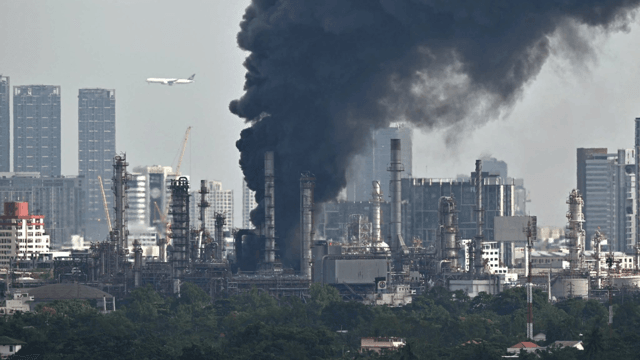



Air quality surrounding the Bangchak oil refinery in Bangkok's Phra Khanong district remains within safety standards, with chemical contamination levels steadily declining following Thursday's blaze, health and environmental officials said on Friday.
The Pollution Control Department's Air Quality and Noise Management Bureau deployed a mobile monitoring unit to track ambient air quality around the refinery from 10pm on Thursday until 8am on Friday.
Hourly average readings during the 10-hour period showed PM2.5 levels between 10.8µg/m³ and 23.93µg/m³, while PM10 levels stood between 23µg/m³ and 54µg/m³ (micrograms per cubic metre).
Gaseous pollutants also remained well below safety thresholds, with sulphur dioxide at 0-1.6 parts per billion (ppb) against a 100 ppb standard, nitrogen dioxide at 18–27 ppb compared with a 120 ppb limit, and ozone at 3–4 ppb against a 100 ppb standard.
Preliminary assessments indicated no adverse air quality impacts from the fire across the measured parameters, though the bureau said it will continue round-the-clock monitoring and issue regular updates to nearby communities.
Meanwhile, the Bangkok Metropolitan Administration (BMA)’s Health Department’s Deputy Director Paitoon Ngammuk said officials have been monitoring air quality since 5pm on Thursday, designating Wat Bang Na Nok School, located about 1.5 kilometres from the refinery, as a key observation point for potential chemical exposure.
Benzene levels at the school dropped from about 0.84µg/m³ at 10pm on Thursday to roughly 0.3µg/m³ by 10am on Friday, remaining below the 24-hour surveillance threshold.
Paitoon said air contamination is trending downward and conditions should return to normal within about three days, barring unfavourable weather or atmospheric pressure changes that could slow pollutant dispersal.
City Hall has divided surrounding areas into three surveillance tiers: a red zone within a 1km radius of the refinery, a yellow zone within 1-3km, and a green safe zone.
Residents in the red and yellow zones have been advised to suspend outdoor activities, while authorities are considering temporary school closures in high-risk areas.
Vulnerable groups, including children, women and bedridden patients, have been urged to remain inside with doors and windows closed, avoid drawing in outside air and wear face masks if going outdoors is unavoidable.
The BMA has mobilised staff from all 34 public health centres, alongside community networks, to check on residents in the red zone, and distributed emergency response plans to district offices and schools in case conditions change.