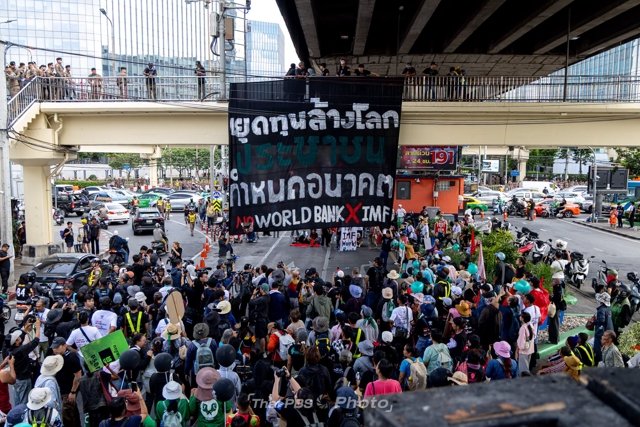



As global finance leaders gather in Bangkok for the annual meetings of the International Monetary Fund (IMF) and the World Bank Group—marking their return to the Thai capital after 35 years—a powerful voice from the region’s environmental movement has emerged.
Representing thousands of participants from Bangkok Climate Action Week (BKKCAW), a broad coalition of civil society groups, businesses, policymakers, and communities has issued an open letter calling on global financial leaders to abandon extractive economic models and embrace a regenerative economic paradigm.
The open letter, released as BKKCAW concludes its week-long series of more than 330 events involving more than 200 regional organisations, warns that incremental policy adjustments are no longer enough to tackle compounding global crises.

A Critical Choice for Southeast Asia
“We have two paths,” the coalition states in the letter. “We may continue under the old economic system that continuously exploits natural resources and people, facing intensifying crises... or we can together change direction towards a new development model that leads to recovery, resilience and the shared well-being of present and future generations.”
The coalition emphasizes that Southeast Asia holds over a quarter of the global biological treasury and is already proving that alternatives work. From community-led bioeconomy initiatives to time-tested agricultural practices like integrated rice-fish systems, the region is demonstrating how economic development can go hand in hand with ecosystem regeneration.
10 Pillars for a Sustainable Economy
To shift from theory to action, the open letter outlines 10 core pillars for collaboration with the World Bank and IMF:
Measure What Matters: Move beyond GDP by embedding environmental and social metrics into credit ratings, loan assessments and policy design, expanding upon the World Bank’s natural capital accounting.
Align Financing with Global Goals: Match financial flows with the Paris Agreement and the Kunming-Montreal Global Biodiversity Framework, while phasing out harmful fossil fuel and agricultural subsidies.

Finance Just Transitions: Prioritise investments in clean energy grids, community-owned renewable energy, and regenerative food systems that support local food security and farmer livelihoods.
Prevent Over Reconstruct: Shift proactive lending toward pre-disaster prevention rather than relying solely on reactive post-disaster recovery, integrating climate risk into IMF macro-economic surveillance.
Protect Public Spending: Support debt reduction and restructuring to ensure developing nations maintain fiscal space for vital social and environmental programmes.
Direct Access to Nature-Care Finance: Create long-term, flexible financial mechanisms that allow indigenous populations, peoples, local communities, and small-scale regenerative producers to access funding directly.
Uphold Rights and Benefit-Sharing: Guarantee that investments respect community land rights, customary tenure, and traditional knowledge while fairly distributing revenues.
Address Loss and Damage: Provide proportional grant funding from historically responsible institutions to communities suffering climate-driven losses.
Strengthen Public Participation: Open policymaking to marginalised voices, including women, youth, indigenous populations and vulnerable groups.
Evolve Development Partnerships: Foster South-South and regional green economic partnerships built on technology transfer, science, innovation, and shared economic security.

A Call for Lasting Resilience
The release of the open letter follows intense local discussions on urban flooding, extreme heat, and PM2.5 pollution affecting Bangkok. Organisers hope the high-profile meetings will prompt global institutions to rethink how international finance can support a resilient, inclusive future for Southeast Asia and beyond.
PHOTO Courtesy of BKKCAW