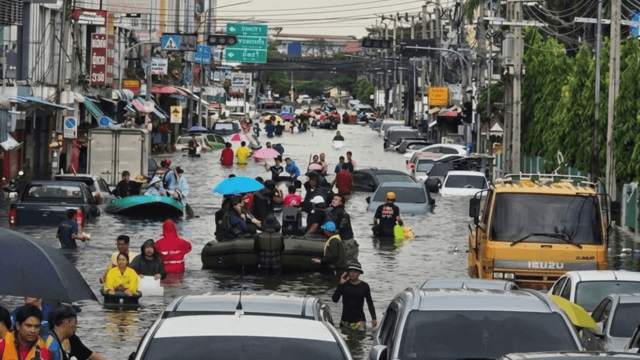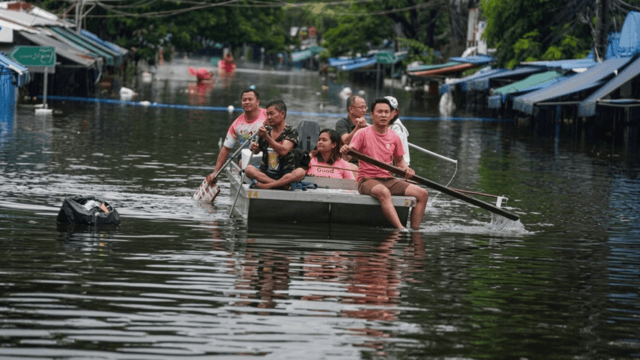



The economic impact from the severe flooding in Greater Bangkok is estimated at 3–5 billion baht, while the overall loss for Thailand’s economy after calculating the damage suffered by 21 affected provinces, as of September 27, could reach 5–10 billion baht.
The cost is calculated based on damage to property and household appliances, such as cars, air-conditioners, fans, washing machines, and refrigerators, according to Associate Professor Dr. Thanavath Phonvichai, president of the University of the Thai Chamber of Commerce and advisory chief of its Economic and Business Forecast Centre.
Spending on flood management and prevention by authorities has also been factored in the total, Thanavath noted.
The impact on tourism is expected to be short-term, provided damage in other parts of the country is contained, he added. However, he warned of the heavy rains moving toward the western region after the cloud cover shifts away from Bangkok.
El Niño exacts a heavy price
Bangkok Governor Chadchart Sittipunt declared all 50 districts of the capital as disaster zones on September 25 following continuous rainfall that led to widespread flooding. Other provinces along the eastern coast have also been affected by extreme weather, driven in part by a super El Niño.
According to experts, the super El Niño has raised sea temperatures, causing massive water vaporization into the atmosphere.
“It is very hard to estimate how much water vapor is in the air. I did not expect the flooding that Bangkok is experiencing today to be this huge,” Thon Thamrongnawasawat, one of Thailand’s most renowned marine ecologists, posted on his Facebook page on Monday.
Residents and critics have blamed government agencies and the Thai Meteorological Department for failing to warn the public early enough. Many residents received a warning around 9.20am on Saturday, September 26, from the National Disaster Warning Center of the Department of Disaster Prevention and Mitigation, but many homes had already been inundated on Friday night.
“Officials are usually very cautious when issuing warnings because they must follow strict procedures and do not know exactly how much each local area will suffer,” says Chawalit Chantararat, the chief executive officer at Team Group PCL, which specializes in water resource management and closely monitors weather conditions.
Timely warnings would lessen the impact on residents, business property and home appliances, as people could move their belongings to higher ground before the flood waters hit.
Broader economic risks and forecasts
Financial institutions, including the Asian Development Bank (ADB), had previously warned about the risks of a strengthening El Niño impacting the Thai economy this year and next. Apart from weather-related risks, Thailand faces headwinds from higher oil prices and elevated household debt affecting domestic consumption.
The ADB had recently revised Thailand’s economic growth upward to 2 per cent for 2026 from 1.8 per cent in July 2026, but projected 1.9 per cent for 2027, down from the earlier forecast of 2 per cent.
Stronger merchandise exports—particularly technology-related products—robust private investment, and government support backed the upward revision for 2026, offsetting weaker tourism and higher energy costs.
Growth is projected to moderate slightly in 2027 as technology export growth normalizes. Lower energy prices, recovering tourism and the continued implementation of promoted investment projects should support next year’s growth, according to the ADB.
ADB has cautioned about downside risks to the outlook. Further escalation of geopolitical tensions could prolong high energy and transport costs, weaken household purchasing power, and disrupt trade and tourism.
Additionally, a greater impact from higher US tariffs or a sharper normalization in the global technology cycle could weigh on exports and investment, particularly in 2027. Domestically, high household debt and tight credit conditions may constrain consumption, while narrowing fiscal space could limit government and state enterprise investment. Stronger El Niño effects could also reduce agricultural output and farm income.
Upward inflationary pressures could be stronger than expected. “Headline inflation could exceed forecasts if geopolitical tensions intensify, cost pass-through intensifies, or a more severe El Niño raises food prices beyond expectations,” the ADB noted.
Agricultural and climate challenges
Team Group CEO Chawalit has warned that rice production could be severely affected next year due to drought in parts of the country. “Rice exports could be lower by 20 per cent next year,” he cautioned.
He added that while Bangkok might manage tap water supplies, rural village waterworks could face severe raw water shortages.
Despite flash floods in several provinces, many reservoirs and dams currently hold lower water reserves. Furthermore, wildfires could intensify and cause severe air pollution if proper management plans are not put in place in advance.
Thanavath warned that the impacts of extreme weather would likely intensify in the future. Weather extremes, partly triggered by global warming, have caused severe flooding across northern, northeastern, central, and southern regions in recent years, alongside wildfires in the north that degrade air quality, threaten public health, and harm the tourism industry.
By Thai PBS World’ Business Desk