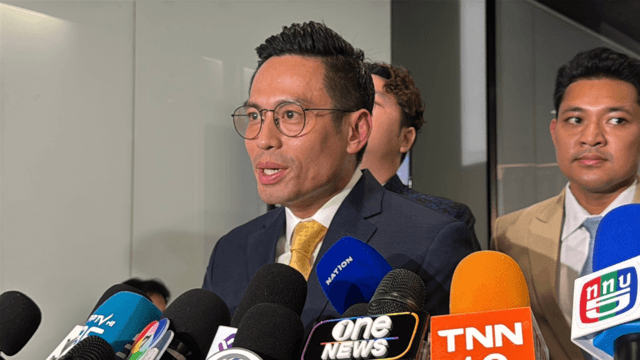
Gen Somsak Rungsita, the new head of the Thai government's southern peace dialogue panel, faces the tough task of negotiating an end to conflict with insurgent groups in the country’s restive deep South – a mission all five of his predecessors have failed to achieve.
He was appointed by the National Security Council (NSC) in early October, just days after the new administration led by Prime Minister Anutin Charnvirakul assumed office.
The post was left vacant after PM Srettha Thavisin was removed from office by the Constitutional Court in August 2024. The government of his successor, Paetongtarn Shinawatra, left the position unfilled.
General Somsak, 65, was a surprise choice for the role of chief negotiator, despite having served as NSC secretary-general six years ago. However, his candidacy was reportedly backed by Defence Minister General Nattaphon Narkphanit, who succeeded Somsak as NSC chief in 2020.
Somsak emphasised that the government is ready to engage in dialogue with all insurgent groups to achieve lasting peace in the deep South. However, he cautioned that talks must involve genuine insurgent representatives with authority to secure any positive progress.
He added that, given the government’s limited time left in office, no significant changes would be made to the existing peace mission, including Malaysia's role as facilitator.
“More importantly, Thailand's role must be clearly and firmly defined to avoid being overly influenced by negotiating counterparts, as happened in the past,” he said.
Army-dominated talks
All but one of the five deep South negotiating teams appointed by successive Thai governments since 2013 have been led by a retired Army general.
The government of Yingluck Shinawatra kicked off the renewed peace push in 2013, appointing then-NSC chief Lt-General Paradorn Pattanathabutr to spearhead the effort.
Under Yingluck’s successor, General Prayut Chan-o-cha, three more generals were named to head successive teams – General Aksara Kerdphol, General Udomchai Thammasarorat, and General Wallop Raksanoh.
The only civilian to head the peace effort was NSC secretary-general Chatchai Bangchuad, appointed under Srettha’s government.
The appointment of General Somsak, another Army general, met with criticism among opposition MPs and residents of the Muslim-majority southern border provinces.
Critics argue that negotiators linked to the military – which is accused of serious human rights abuses in the deep South – cannot act as neutral mediators between Thai security forces and Muslim insurgent groups.
Others queried the reason for appointing Somsak, noting that the government’s expected four-month term would be too short for him to complete the task. They suspect that the authorities simply wanted to spend the annual 20-million-baht budget allocated for the mission.
Anutin was voted in as Thailand’s 32nd prime minister in September after the opposition People’s Party pledged to support his candidacy on condition he dissolved the House of Representatives for a fresh election within four months of assuming office.
Since 2004, the deep South has witnessed 10,059 attacks, leaving 5,989 dead and 13,445 injured. The insurgency resurfaced in January that year after around 150 insurgents raided a Narithawat Army depot, killing four guards and making off with 413 assault rifles and ammunition.
Deep South Watch, a local think tank, has recorded over 23,000 violent incidents leading to more than 7,000 deaths over the past 21 years.
Career military man
Somsak was born on March 25, 1960, in the northeastern province of Udon Thani. He graduated from the Armed Forces Academies Preparatory School (AFAPS) and the Chulachomklao Royal Military Academy (CRMA).
He won a scholarship to the Virginia Military Institute in the US, earning a bachelor's degree in electrical engineering with first-class honours, then a master's degree in electrical engineering from the Virginia Polytechnic Institute and State University (Virginia Tech).
He entered the military in 1983 as a radio technician at the Royal Thai Army's Signal Department while also teaching at his alma mater, CRMA.
After graduating at the top of his class from the Command and General Staff College, he was assigned to the Army's Directorate of Operations, where he worked for over two decades.
In 2013, he was appointed director of the Office of Policy and Strategy, his first job at the Defence Ministry’s Permanent Secretary's Office. He later held other key positions in the ministry's Office of Defence Policy and Planning.
Somsak rose to deputy permanent secretary for defence in 2018, became NSC secretary-general a year later, and reached mandatory retirement in 2020.
Following his retirement, he received the Chak Dao Award, which recognises outstanding AFAPS alumni for their contributions to the country.