


Three enormous whales appear to be swimming in the forest in northeastern Thailand. Their broad backs rise above the tree canopies, pointing towards the Mekong River and Laos’ forest and mountain landscape. From a bird’s eye view, the whales of Isaan are captivating.
Of course, the whales are not real.
These are the sandstone formations of Hin Sam Wan, or Three Whale Rock, in Bueng Kan province. Millions of years of weathering have rounded their backs and carved deep channels between them. You can walk out onto two of the three formations, where the view opens across a vast stretch of forest towards the Mekong. That view is stunning – both through your eyes andfor those watching you sitting on the stone whale.
The Whale Rock is an unusual introduction to Bueng Kan, Thailand's youngest province, and the starting point for a road trip south to Nakhon Phanom. Along the way, mountains with wooden walkways clinging to their cliffs, caves with rocks resembling snakeskin, and riverside temples where stories of the Naga, the mythical serpent of the Mekong, are still very much alive.
Driving from Bueng Kan to Nakhon Phanom, the quiet yet mysterious section of Mekong River, you will see a landscape written in stone.
Bueng Kan became Thailand's 77th province in 2011, but it’s well away from the country's main tourist routes.
A short drive inland from the provincial capital brings you to Phu Sing, where sandstone formations rise among the trees in all sorts of strange shapes. Some resemble giant mushrooms, with broad caps resting on narrow stems. Others look as though they might topple over at any moment.
The rocks have been shaped over millennia by water and weathering. So, what rolls around yourwindshield and side-windows is a landscape of overhangs, rounded boulders and curious rock formations.
Three Whale Rock gets most of the attention, particularly in the early morning when the light is soft and the forest below is covered in mist. But there are other viewpoints and walking trails worth exploring. Away from the main viewing areas, there are stretches of forest where you may hear little more than birdsong. On a clear day, the hills of Laos are visible beyond the Mekong.

A mountain for meditation
Thirty minutes ride south of Three Whale Rock, you arrive at the Buddhist temple of Wat Phu Tok. Here, the sandstone takes on a different role.
The mountain rises steeply from the surrounding countryside, its cliffs encircled by wooden walkways that seem too fragile to even step on. Built at different levels, they connect caves, meditation areas and small shrines tucked into the rock face.
The temple was developed by a respected local forest monk. The walkways were constructed to give monks access to quiet places for meditation. The mountain monastery also draws visitors for its stunning panoramic views and sense of adventure from the stairway to tranquility (and fear of heights).
The climb starts gently enough, with wooden stairs leading through the trees. Higher up, the route becomes more exposed. Some walkways follow the cliff face, with wooden railings on one side and a considerable drop beyond.
The views are impressive. Forests, fields and villages spread out towards the horizon.

Into the realm of the Naga
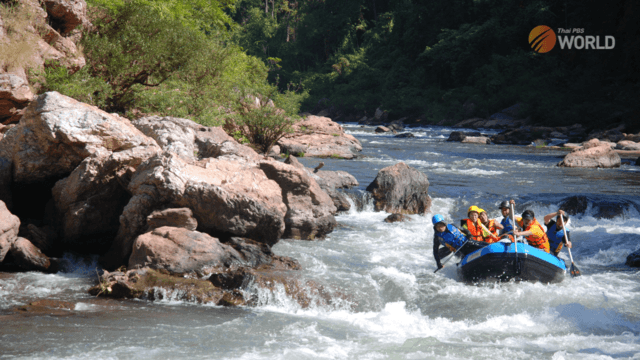
After the adrenaline rush and majestic views of Wat Phu Tok, you head south for 50 kilometers to Kaeng Ahong. Back beside the Mekong, the widespread rapids offer a change of scenery.
Near Wat Ahong Silawat, the river flows past a rocky stretch traditionally known as the navel of the Mekong. Local people associate the deep waters here with an abode of the Naga, a mythical serpent.
Naga stories are deeply rooted in the cultures of northeastern Thailand and Laos. Their images appear on temple staircases, rooftops and religious monuments, often guarding entrances to sacred places. Along the Mekong, they are also associated with the river's mysterious depths.
The connection becomes more striking at Naka Cave, in Phu Langka National Park, further south in Bueng Kan province.
Getting there is an adventure in itself. The trail climbs steeply through forest, with rocky steps, staircases and sections where ropes help hikers negotiate the slope. It's a demanding walk.

The reason for the climb soon becomes clear. Across several large sandstone surfaces are patterns that look like the scales of a giant snake. Some rocks have rounded, overlapping markings, while others are split by long cracks that suggest the outline of a serpent's body.
Local inhabitants believe that a Naga was turned to stone. The geographical wonder together with the myth have made the cave a popular destination, attracting visitors who come to pay their respects as well as those interested in the unusual geology.
The patterns themselves are natural, formed through geological processes including fracturing and weathering. But standing before the rocks, you may feel a chill running through your spine.

From Bueng Khong Long, the journey continues into Nakhon Phanom province, passing villages, farmland and the wooded slopes of Phu Langka.
On the Nakhon Phanom side of the national park lies Nakee Cave, another site with unusual sandstone formations associated with Naga mythology. Despite their similar names, Naka and Nakee are separate destinations, each requiring its own hike.
Visiting both is possible, but it means setting aside considerable time for trekking. If you've already explored Naka Cave, you might prefer to continue towards the Mekong, stopping along the way for a meal or a look around a village temple.
The countryside here is typical of the rural Northeast. Rice fields spread across the lowlands, rubber plantations occupy the hillsides, and small settlements appear along the road. At local restaurants, grilled chicken, sticky rice and som tam make an easy lunch.
The drive is not always beside the river. Much of the route runs inland, through farming communities and wooded hills, before turning east towards Nakhon Phanom.

Where the river meets belief
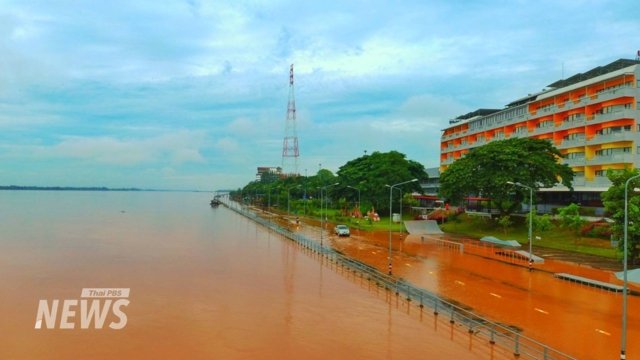
The Mekong comes back into view at Nakhon Phanom. The river is wide here, with the steep mountains of Laos rising beyond the left bank. Between November and February, the cooler months often bring clear mornings and good views across the water.
Nakhon Phanom is a good place to spend an afternoon without much of a plan. The town has a long riverside promenade, old buildings, cafés and restaurants. By late afternoon, people are out walking or cycling, while others settle on benches facing the river.
The waterfront is also home to Phaya Sri Sattanakharat, a seven-headed Naga monument that draws a steady stream of worshippers. Flowers and incense are placed in front of the statue, and visitors kneel to pray or ask for blessings. A few steps away, people stop for photographs or sit watching the boats on the Mekong.
The Naga has appeared in different forms along this journey, from the serpent-like sandstone at Naka Cave to the religious imagery of riverside temples. In Nakhon Phanom, it occupies a prominent place in the town’s public life.